UC Davis receives historic donation
The newly renamed Joan and Sanford I. Weill School of Veterinary Medicine was given its largest-ever monetary gift.
A $120 million donation to the University of California (UC), Davis, was announced today as the largest gift ever made to veterinary medicine worldwide. The gift was made by philanthropists Joan and Sanford I. Weill in support of the UC Davis veterinary school, through the Weill Family Foundation.1
The university has renamed the school the University of California, Davis, Joan and Sanford I. Weill School of Veterinary Medicine—or the UC Davis Weill School of Veterinary Medicine—in recognition of the namesake family’s commitment, according to the university. The historic gift is also one of the largest ever received by UC Davis.1
“UC Davis is home to one of the world’s most outstanding veterinary schools and many of the brightest minds in animal and human medicine,” Sanford “Sandy” Weill, former CEO for Citigroup and a member of the UC Davis Chancellor’s Board of Advisors, said in a news release.1,2 “We are proud to support an institution where groundbreaking research and compassionate care are prioritized together, and where discovery benefits both animal and human health.”
The Weills have also credited the UC Davis veterinary school with caring for one of their pet dogs. When their bichon frisé, Angel, was diagnosed with lymphoma in 2018, the care the dog received at UC Davis left an impression on the family. In a Bloomberg interview, Joan Weill said the family has become more involved in the school over the years and has witnessed its leadership, dedication to science, initiative in solving complex medical challenges, and commitment to patients and their families.2
According to Bloomberg, the Weills have given approximately $1.5 billion to educational, medical, and cultural institutions, including now more than $500 million to the University of California system. Other contributions have included a $106 million gift for brain disease research to UC Berkeley, UC San Francisco, and the University of Washington.2
“By naming our veterinary school in Joan and Sandy’s honor, we celebrate their transformative generosity and lasting commitment to improve the health of all species,” Gary S. May, PhD, MS, chancellor for UC Davis, said in the release.1 “UC Davis is world-renowned for excellence in veterinary medicine, research, and service. We are deeply grateful for Joan and Sandy’s vision and partnership to help us accelerate the great work taking place here.”
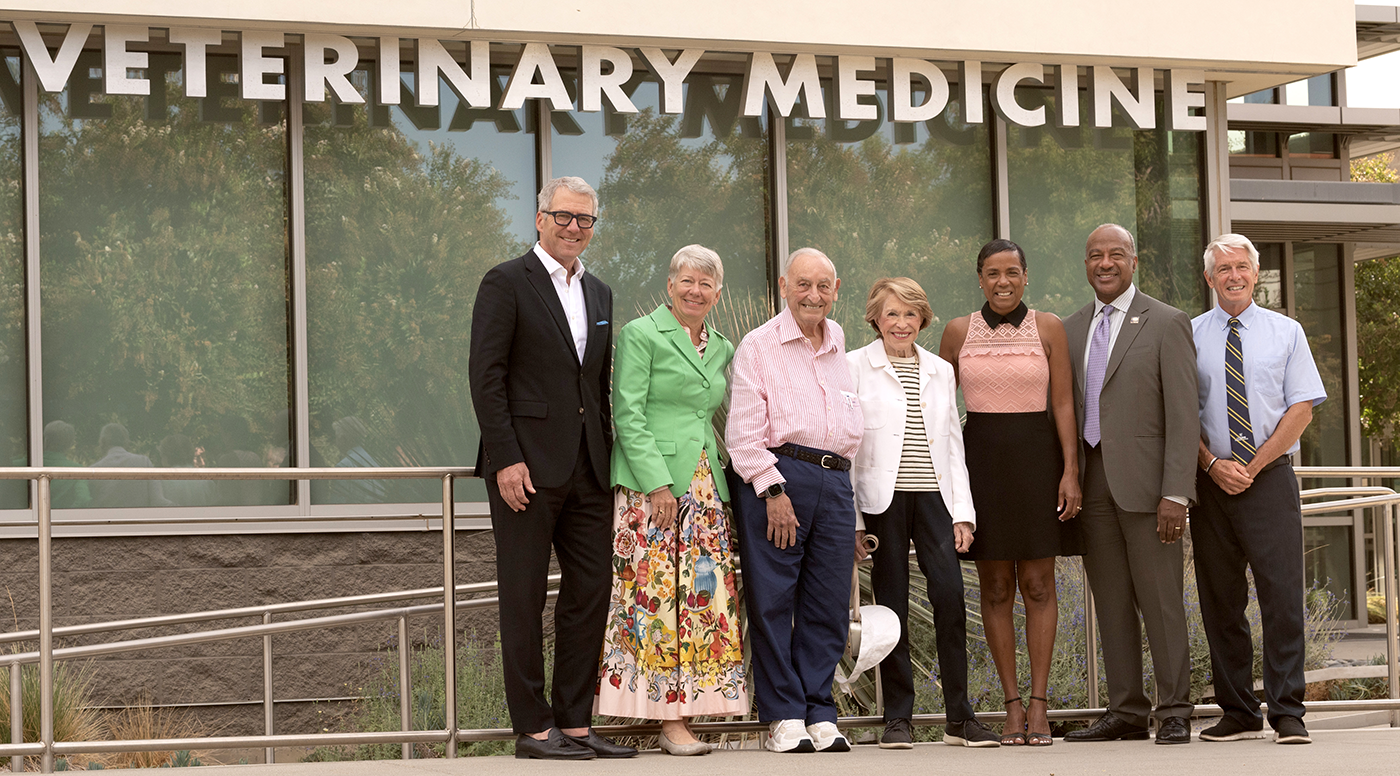
Mark Stetter, DVM, DACZM, dean of the UC Davis Weill School of Veterinary Medicine, said the Weills’ support will revolutionize what is possible in veterinary medicine. “Joan and Sandy Weill’s extraordinary generosity will allow UC Davis to move faster, think bigger, and rise to meet the most urgent challenges facing our world,” Stetter said. “This gift empowers us to drive discoveries, expand access to world-class education, and develop new insights at the intersection of veterinary and human health. It launches an exciting new era in veterinary medicine and provides the catalyst needed to advance the construction of our new hospital. With continued support from our philanthropic community, we can bring this vision to completion.”
The $120 million gift from the Weills aims to strengthen UC Davis’ leadership in the field of comparative medicine and advance translational research initiatives for diseases that affect both animals and humans, such as cancer, neurological disorders, and cardiovascular conditions. Eighty million dollars of the donation is earmarked for the construction of a new small-animal teaching hospital, which is part of the university’s $750 million planned expansion of its veterinary medicine complex that will allow UC Davis to increase student capacity.1,3
As part of the expansion, in September 2025, UC Davis announced the opening of the All Species Imaging Center, with the goal of this new facility becoming the central hub for advanced diagnostic imaging at the UC Davis William R. Pritchard Veterinary Medical Teaching Hospital. The veterinary medicine complex is expected to continue evolving with multiple new facilities that will enable the university to provide care to approximately 20,000 more animals each year. Planned facilities for the complex expansion include a veterinary education pavilion, a primary care hospital, an equine hospital, a cancer center, a spay-neuter clinic, and a raptor center.3
Meanwhile, the remaining $40 million from the Weills’ gift will be dedicated to fundamental and clinical research. The funds will be used to “accelerate team science, support early-stage discovery projects, and enable faculty to pursue high-impact ideas that often fall outside traditional funding sources,” the university said in the release.1
References
- Tompkins C. UC Davis receives $120M gift, largest ever to veterinary medicine. University of California, Davis. January 28,2026. Accessed January 28,2026. https://www.vetmed.ucdavis.edu/news/uc-davis-receives-120m-gift-largest-ever-veterinary-medicine
- Maglione F. Weill gives $120 million to vet school that treated his dog. Bloomberg. January 28, 2026. Accessed January 28, 2026. https://www.bloomberg.com/news/articles/2026-01-28/weill-gives-120-million-to-vet-school-that-treated-his-dog?srnd=phx-wealth&embedded-checkout=true
- Crossley KC. UC Davis unveils a new diagnostic imaging center. dvm360. September 20, 2025. Accessed January 28, 2026. https://www.dvm360.com/view/uc-davis-unveils-a-new-diagnostic-imaging-center