FDA approves maropitant citrate injectable solution
The approval of Emeprev will help veterinary professionals by providing an in-clinic antiemetic option.
Dechra announced today that it has received FDA approval for maropitant citrate (Emeprev; Dechra), an injectable solution to prevent and treat acute vomiting in canine patients as well as vomiting in feline patients. With this approval, Dechra shared that Emeprev is now the first FDA-approved bioequivalent injectable solution to "the most widely used antiemetic for dogs and cats."
“Emeprev delivers the same trusted antiemetic effectiveness as the pioneer with a different preservative. It's a win for our patients and their caregivers,” said Christopher Byers, DVM, DACVECC, DACVIM (SAIM), CVJ, a key opinion leader for Dechra.1
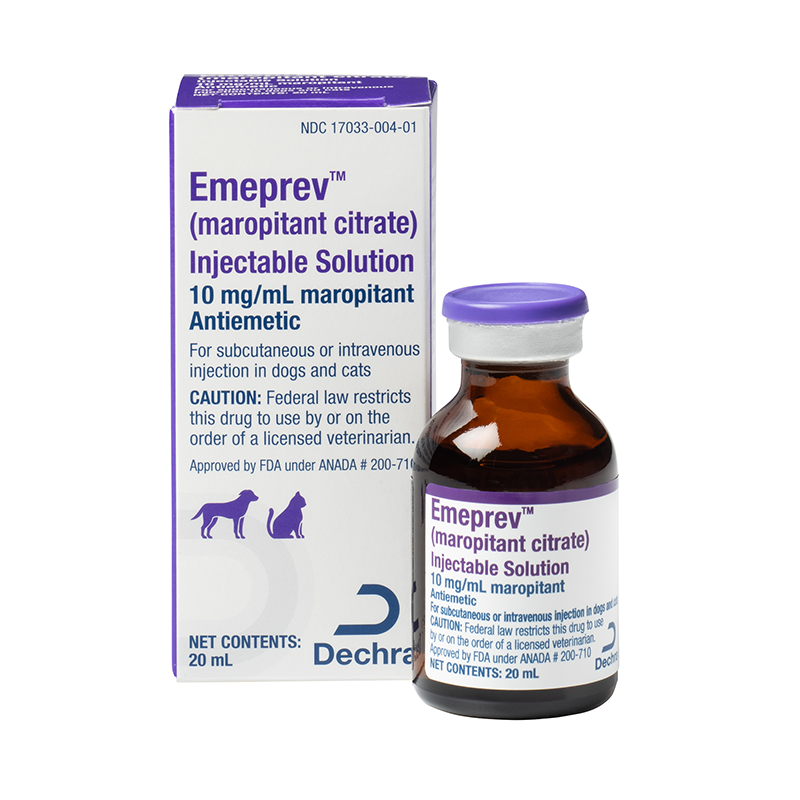
According to a study conducted in February 2018, Emeprev contains benzyl alcohol, which is a preservative demonstrated to act as a local anesthetic and reduce pain during injection in healthy laboratory dogs.2 The study was made up of 32 purpose-bred beagle canines (15 male and 17 female), all between the ages of 8 months and 3 years, with a weight between approximately 13.6 and 26.5 lb. All 32 dogs enrolled in the study also completed the study.
The study was a blinded, randomized, crossover study conducted according to a 4-period, 4-sequence, 4-treatment Latin square design, in accordance with the principles of good laboratory practice. Female and male dogs were randomly assigned separately. The dogs then received 4 subcutaneous injections of 1 mg/kg maropitant with at least 3 days between treatment periods.2
According to the study, 2 formulations of maropitant 10 mg/ml solution for injection were tested: metacresol-preserved formulation (Cerenia; Zoetis) and benzyl alcohol–preserved formulation (Prevomax; Dechra). Each formulation was tested at both refrigerated (4 ºC) and room temperatures (25 ºC). Approximately 1.5 to 2 hours prior to administration, one vial of each test item was placed on an ice bath (approximately 4 ºC), and another vial of each test item was put on a preheated water bath (approximately 25 º C).
Throughout the 4 treatment periods, the same dose volume was administered to the patients. The injection pain was also assessed independently by 2 veterinarians, blinded to treatment allocation, and immediately after the administrator announced injection of the product, pain was scored through the visual analogue scale. The patient was then observed for 2 minutes, and a simple descriptive scale was assigned.
The study's conclusion found that in the healthy beagles, the subcutaneous injection, administered at both room and refrigerated temperatures, is significantly less painful than the maropitant solution for injection with metacresol as a preservative. Dechra stated in its release that because the product does not require refrigeration, it can help clinics streamline their operations.
“The introduction of Emeprev injectable solution builds on our continued commitment to providing veterinarians with high-quality, practical solutions they can trust,” said Laura Olsen, chief marketing officer and president of North America for Dechra.1 “We’re focused on expanding our companion animal portfolio with products that address real-world clinical needs and strengthen the human-animal bond.”
Emeprev is indicated for vomiting in cats 4 months and older, and for acute vomiting in dogs 2 to 4 months of age, or for either subcutaneous or intravenous administration in dogs 4 months of age or older. Safe use has not been evaluated for cats and dogs with gastrointestinal obstruction or those that have ingested toxins.1
Emeprev will be available through all major veterinary distributors in early 2026.
References
- Dechra announces FDA approval of Emeprev (maropitant citrate) injectable solution. News release. Dechra. December 8, 2025. Accessed December 8, 2025. https://www.dechra-us.com/news/2025/december/dechra-announces-fda-approval-of-emeprev-maropitant-citrate-injectable-solution
- Deckers N, Ruigrok CA, Verhoeve HP, Lourens N. Comparison of pain response after subcutaneous injection of two maropitant formulations to beagle dogs. Veterinary Record Open. 2018;5(1):e000262. doi:10.1136/vetreco-2017-000262