Did we win today? Turning business into a game everyone can play
When your clinic’s revenue looks like a glucose spike and your expenses read like anemia, suddenly, business isn’t so boring.

We still remember our first few attempts at sharing financial data with the team. The idea was simple: Transparency builds trust and engagement. We wanted everyone in the clinic to understand how the business was doing, so we pulled together our revenue, profit, expenses, and average check transaction (ACT) and presented them in a town hall.
People listened with interest for about 5 minutes.
Then we noticed the glazed expressions and people shifting in their seats, sneaking glances at their phones, and mentally checking out. We realized it’s not that people didn’t care—it’s that they didn’t understand what to do with the information or how these numbers related to them.
When it doesn’t click, everything costs more
We’ve both worked in hospitals where business operations were totally opaque. Most people had no idea how the practice was performing, what it cost to run, or how they could help.
When you don’t see the big picture, you focus on what you can control: your own schedule, effort, and outcomes. However, without insight into the clinic’s financial health, even well-intentioned choices can quietly work against it. That might look like charging for a 5-minute ultrasound while performing a full abdominal scan, opening 6 syringes when 1 would do, or not pushing for efficiency because there’s no clear reason to.
It can also mean expecting bonuses or raises without understanding what needs to happen financially for them to exist. Without visibility into profitability, people don’t have the context to act differently.
Open-book management isn’t enough
At a previous clinic where I worked, leadership shared revenue numbers but left out the expenses. Without context around salaries, rent, inventory, or overhead, it started to seem like $10,000 a day went straight into management’s pocket. When the reality of operational costs isn’t part of the picture, even well-meaning transparency can breed resentment instead of trust.
For best practices on open-book management, we leaned on The Great Game of Business by Jack Stack, a book focused on building business literacy, identifying “critical numbers,” and tying team rewards to collective success.
The key idea is that if people don’t understand the rules, they can’t play the game. And if they can’t play the game, they can’t win.
Presenting numbers in Microsoft Excel was…dry. So we asked: What’s a framework that every veterinary team already knows and understands intuitively?
Blood Work
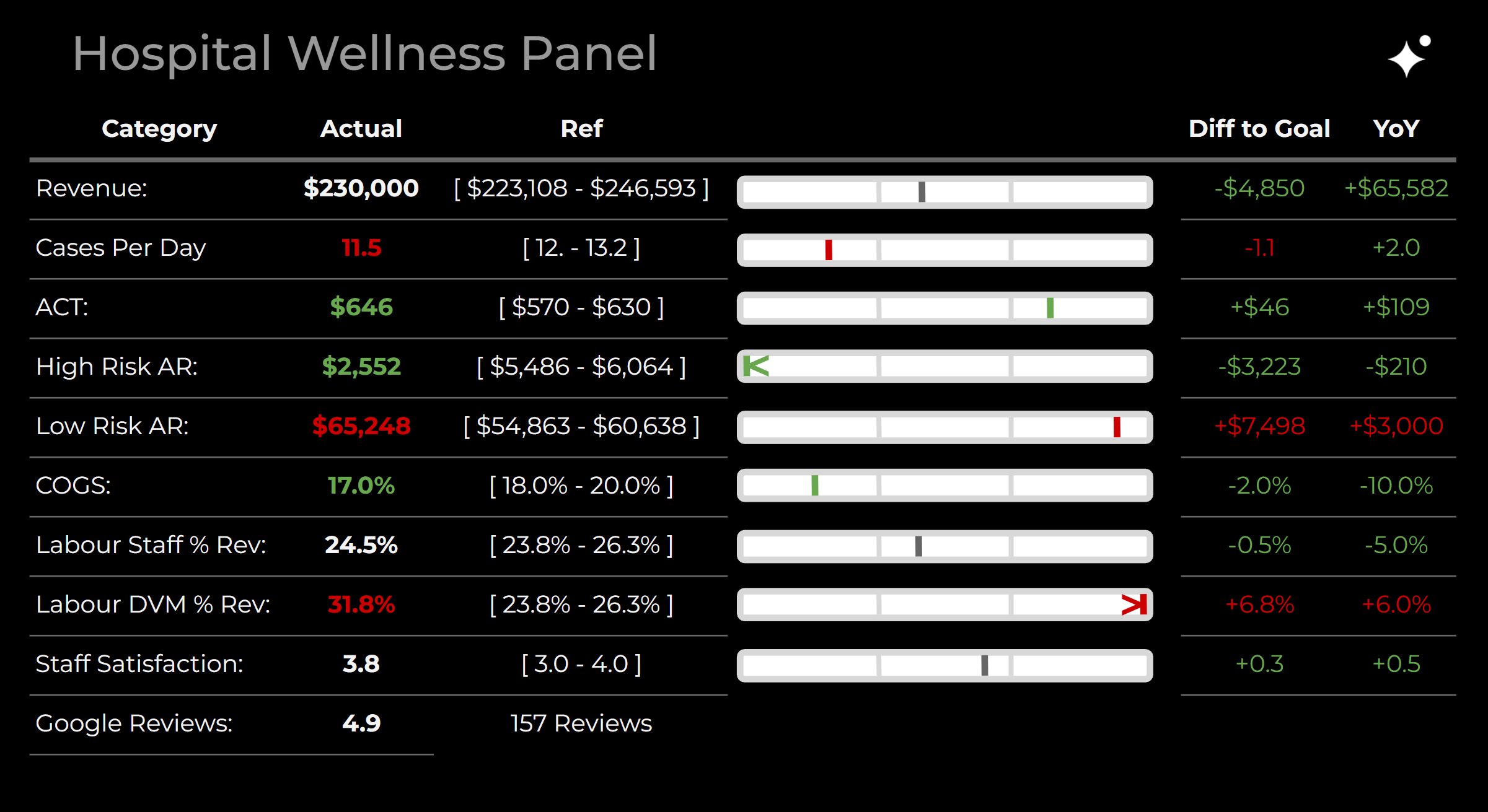
Veterinary teams look at diagnostic panels every day. They are used to reading values in relation to a reference range, spotting trends, and comparing current results to previous baselines. So we applied that same logic to our business metrics.
We started visualizing our core financial and operational numbers, revenue, expenses, caseload, ACT, cost of goods sold (COGS), labor, and more, as if they were values on a wellness panel. Each has a reference range, a current reading, and a color-coded indicator showing whether it’s high, low, or within normal limits.
By framing metrics this way, we didn’t have to explain what was good or bad, high or low—it was instantly recognizable. People could interpret business performance just like they interpret a blood panel. Reading the numbers became second nature. And more importantly, people started asking the right questions: Why is this low? What changed since last month? How do we bring it back into range?
That’s when we knew it was working.
The business became everyone’s patient
Once people could see the data, we needed a way to act on it, so we borrowed another clinical staple: the SOAP note.
- Subjective: Anecdotal or historical insights (such as, “It’s summer, and we’re seeing more general practice cases than usual.”)
- Objective: Observable facts (such as, “Revenue is down, but caseload is up.”)
- Assessment: Our interpretation (such as, “ACT is down, possibly due to an influx of low-complexity cases or relief shifts.”)
- Plan: What we’ll do (such as “Train DVMs on case efficiency; reduce relief shifts or review their ACT.”)
This gave us a structure to approach operational issues with the same methodical rigor we use in medicine.
To support this, we built a knowledge base—our “Karol Mathews” of practice management. For every metric, there’s a “value creation tool” with ready-to-use ideas, tips, and solutions. If caseload is low, for example, you’ll find a quick diagnostic checklist: marketing outreach suggestions, front-desk scripting, referral source follow-ups, and more.
When the issue goes beyond the clinic’s tool kit, we treat it like any complex case and bring in “board-certified specialists” (external consultants or our marketing agency) to guide the solution.
Every metric has an owner and a review cadence
In our model, each hospital has team members who volunteer as “directors”—roles like director of marketing, inventory, staff, facilities, or finance.
Each director “owns” a number from the blood panel. That doesn’t mean they’re responsible for fixing it alone; their job is to partner with the right operations team “specialist” and help deploy the value creation tool that can move the metric in the right direction. They don’t need to be the expert; they just need to know where to get help.
This bottom-up system gives everyone a stake in the outcome and real influence over business performance.
It’s also important that there’s a regular review cadence so people stay engaged with the numbers. We run a weekly hospital pulse meeting to track trends, spot issues early, and share updates across departments. We don’t wait for end-of-month reports or annual reviews; progress is monitored in real time, and action happens quickly.
Bonuses follow the same fast pace. We pay them out quarterly rather than annually because feedback loops need to be short. During each quarterly planning meeting, teams set their own goals tied to the profit bonus—goals they choose, understand, and can influence. And with payouts happening just a few months later, the connection between effort and reward stays clear and motivating.
Results we’ve seen so far
Increase in ACT
When one clinic struggled with revenue generation, a veterinarian took initiative and found a study suggesting that when technicians—not doctors—review estimates with clients, ACT tends to rise. We tried it. Two months later, ACT had increased by 11%, tipping the clinic into profitability.
ACT is one of the metrics reviewed collectively by the DVM team, with each veterinarian responsible for their own numbers. As an urgent care group, we can’t control the cases that walk in, but we can control what we’re comfortable diagnosing, recommending, and charging for.
That’s why we also look at revenue by specific areas to identify potential growth opportunities. A low volume of certain procedures may point to a skill gap or an area where someone feels less confident. If someone’s ACT is low, we discuss where they may need more training or practice and invest in continuing education to support them in building that skill.
It’s not about competition over production numbers (production is shared among all DVMs); it’s about a fun race to shine in a certain area. We even have playful titles for team members who’ve mastered specific skills, such as Photographer of the Month for the most x-rays taken, the Scientist Award for the most blood work done in the network, and so on. In addition to supporting professional growth and improving ACT, this kind of goal-setting also helps prevent burnout.1
Tighter inventory
We brought our COGS down from 20% to 22% to 14.8% network-wide. One clinic even hit 12%. A lot of this came from simple behavior change – once people saw how supply costs impacted practice finances (and ultimately their bonus), their day-to-day decisions shifted. Techs started rinsing and reusing tubes. Assistants saved half-used garbage bags. People started asking, “Do we need this? Can we optimize this?” They truly own these expenses, because those expenses are their expenses.
Improved revenue on relief shifts
Our finance director of one of the hospitals noticed that days with relief coverage consistently brought in less revenue. Because relief veterinarians aren’t included in our bonus structure or ownership model, they weren’t connected to the same performance incentives as the rest of the team. To address this, we began offering them production bonuses: If the shift is slow, they earn their standard rate; if it’s busy, they earn more. It was a team-driven solution to a shared challenge—a way to keep relief veterinarians motivated, performance strong, and the system fair for everyone.
Let the games begin!
If you’re looking to build engagement around business performance, here are a few simple ways to get started, drawn from what’s worked for us:
- Find a way to share the rewards. Whether it’s quarterly bonuses or something else, there needs to be a tangible connection between performance and incentive.
- Start simple. Begin with 3 metrics: revenue, expenses, and profit. Add more only once your team starts asking, “How can I influence this?”
- Gamify it. Use familiar frameworks, such as blood work and SOAP notes, to present the information. Frame it in a way that feels familiar and intuitive, something your team already understands.
- Assign ownership. Even without formal titles, people can “own” a number and be the go-to for solutions.
- Create a knowledge base. Share value creation tools so no one solves a problem from scratch.
- Review regularly. Some numbers need weekly attention, others monthly, but if you wait until the end of the year, it’s too late.
- Be patient. The first 5 times you show a number, no one will react. By the sixth, they start asking questions. That’s the tipping point.
At its core, this approach is about building business acumen across the entire team. When people understand how the practice operates and how their actions impact its performance, they start acting like owners. That kind of shared accountability changes everything. And it doesn’t have to come from dry spreadsheets or dense financial reports. By translating the business into a language your team already knows—through gamification, familiar clinical frameworks, and clear incentives—you make it approachable, intuitive, and even fun. When people see the full picture, they show up differently. And when they own a piece of it, they move it forward.
Reference
- Zak I. Veterinary burnout researched and explained. Galaxy Vets. January 19, 2021. Accessed January 9, 2026. https://galaxyvets.com/learning-center/veterinary-burnout-researched-and-explained/